
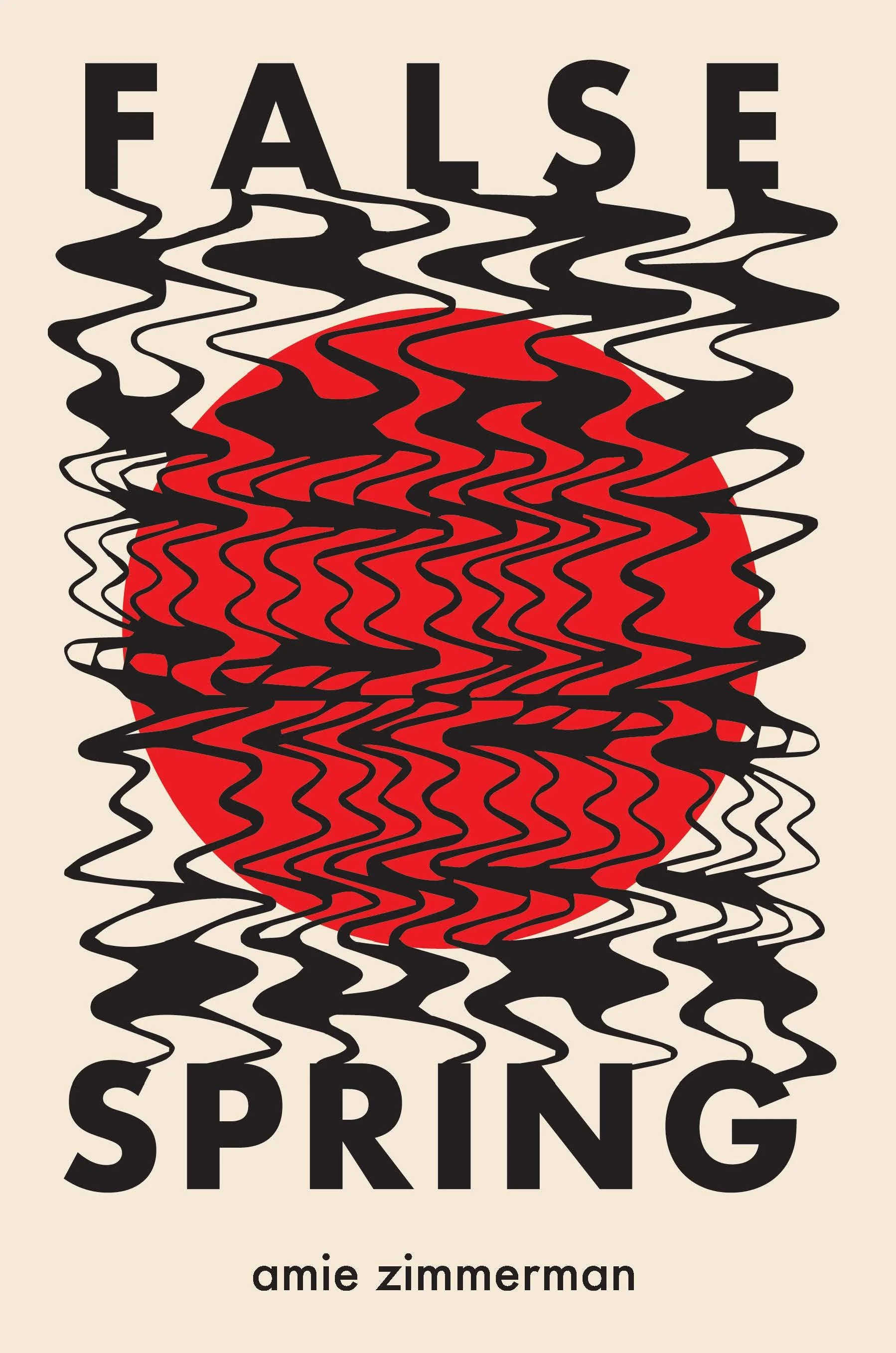
FALSE SPRING
by Amie Zimmerman
Amie Zimmerman’s False Spring, her first collection, rings true in its politics and its form. Today, when poetry’s circuitous approaches remain the norm, Zimmerman tackles the problems of the moment head on: “this war is a real war / voting can’t fix.” Zimmerman is not conciliatory in any meaningful way: “if we organize around the kindness principle / we’ll get bullets in our eyes.” Her politics and her unremitting insistence to be herself appear in the way every word connects to its neighbor: “what is the value of here / here.” False Spring shows the reader how to “…learn / how to love something / more than yourself.”
Organized in three sections, False Spring weaves together fragmented lyric and polemic to expose the contradictions inherent in care, labor, and resistance. The recurring “false spring” motif pings between hope and trauma, while the “Walter Benjamin” poems anchor philosophical inquiry in the body. Zimmerman’s voice is polyphonic, shifting from collective declarations to private implosions, often within the same stanza. Poems like “Surplus” and “the street” confront institutional brutality and economic precarity, while “On the Nature of Bondage” uses constraint-based experimentation to dismantle poetic authority.
Zimmerman’s language is both lush and caustic, invoking flora, bodily fluids, and domestic rituals as sites of renewal and disappointment. The first poem in the last section, “Mother,” refracts love and legacy through riotous tenderness with a gesture toward communal survival and poetic witness. False Spring refuses to offer an elixir for what ails America as a nation today.
People are saying
Unspooling grief and desire for a better world, the poetry in False Spring faces the predicaments of our time line by line, rooted in the experience of fighting back: “this war is a real war/voting can’t fix.” Amie Zimmerman revisits moments in the street and memory in the body, examining the individual in relation to the collective, figuring it out as we go. And sudden beautiful conclusions appear, hard won, opening new paths. This book is a gem.
– Ryan Eckes
The way some of “us” refer to “cycles of struggle” is similar to the logic behind Amie Zimmerman’s debut collection False Spring. There is a familiar feeling here for anyone who knows struggle doesn’t end, and there are no clean breaks between what may, from the outside, appear to be separate struggles. This is really a lovely collection. Zimmerman’s determination to be her own woman riding out the false springs is more than anything a reminder that spring is coming & you don’t want to miss it.
– Wendy Trevino
Unreserved and unsparing, Zimmerman's debut full-length collection, False Spring, engages the quiet and weight of one's conscience in the present moment amidst war and conflict, beginning with the interrogation of self and the absence thereof. Beautiful and timely, Zimmerman questions one's ability to change the character of a nation and its people, when we know its character.
– m.s. RedCherries
About the author
Amie Zimmerman is the author of four chapbooks, including Compliance (Essay Press) and, with artist Samantha Yun Wall, the collaboration 31 Days/The Self (Ursus Americanus). Alongside Hajar Hussaini and Matthew Klane, she co-curates the poetry and performance series Salon Salvage. Zimmerman is from Portland, Oregon, and lives in upstate New York, where she works as a hairstylist, labor organizer, and PhD candidate.